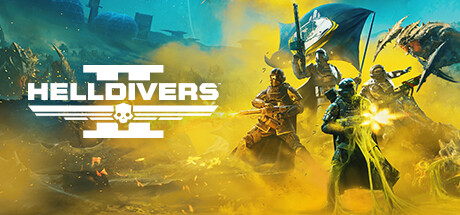
Helldivers 2 had no business being this good. A third-person co-op shooter from a mid-sized Swedish studio, sequel to a game most people had only a passing awareness of, published at a price point well below the current blockbuster standard. It should have been a modest success at best. Instead, it became one of the most talked-about games of 2024 and the reason a lot of people stopped playing whatever they were grinding through at the time. The chaos is the point, and it is brilliant.
Spreading Managed Democracy
The premise is a send-up of militaristic propaganda done with real wit. You are a Helldiver, a soldier of Super Earth dispatched to liberate planets from insects and automatons in the name of freedom, democracy, and a government that is clearly not on the level. The tone is pure Starship Troopers: straight-faced recruitment poster aesthetics undercut by how immediately expendable you are. You will die constantly. You will kill your teammates constantly. None of it matters because you can reinforce and drop back in within seconds, and the whole thing is funny in a way that never wears out its welcome.
The core loop is a mission structure where you drop onto a planet, complete objectives, and extract before the clock runs out. Simple on paper, chaotic in execution. Enemy patrols spawn based on noise levels, meaning a stealth approach is viable until someone calls in a bombardment on their own position. The Stratagem system, where you input directional button sequences to call in weapons, supplies, and orbital strikes, is the mechanical heart of the game. Getting fast at Stratagem inputs while being shot at and flanked by enemies twice your size is one of the more satisfying skills in any shooter released in years.
The friendly fire system deserves particular mention. Damage applies to teammates as readily as enemies, which sounds like a recipe for frustration and is instead a recipe for exactly the right kind of chaos. Nobody is punished harshly for it. You respawn quickly. And the awareness it requires, of where your teammates are before you throw that 500kg bomb, elevates the co-op feel considerably. You are actually a squad rather than four people incidentally sharing a map.
The Weapons and Stratagems
The arsenal is varied and genuinely feels different in use. The Railgun before it was patched into the ground was a community moment in itself, but even in its adjusted state the sandbox offers enough to keep experimentation interesting. Primary weapons, support weapons, backpacks, and orbital calls all interact with the chaos in different ways. Finding the loadout that suits your playstyle, and the playstyle of whoever you are running with, has real depth to it.
Difficulty scaling is handled well. The lower difficulties are manageable with minimal coordination. At the higher end, the game becomes a genuine test of communication, positioning, and loadout knowledge. The Terminid bug enemies and the Automaton robots feel distinct enough in their behaviour to require meaningfully different approaches.
The Warbond system, Arrowhead’s take on a battle pass, offers new weapons and cosmetics at a pace that feels reasonably fair. The premium currency can be earned through gameplay, which takes the edge off the live service elements.
The Launch Problems and the PSN Controversy
Helldivers 2 sold far beyond what Arrowhead or Sony were prepared for. The server capacity at launch was simply insufficient for the player numbers, leading to lengthy queues, failed sessions, and a lot of frustrated players during the first few weeks. Arrowhead were communicative about it and the issues resolved, but it was a rough start.
The bigger flashpoint came months post-launch, when Sony announced a requirement for players to link a PlayStation Network account to continue playing on PC. In regions where PSN is not officially available, this meant a potential loss of access for players who had already purchased the game. The community backlash was significant and fast. Sony reversed the decision. But it highlighted the tension inherent in the platform-holder/developer dynamic and left a bad taste that lingered.
The balance patch history is also worth a mention. Several major updates changed weapons significantly, and some of those changes divided the playerbase on whether they improved or diminished the game. Arrowhead have been responsive to feedback, but the live service nature means the game you play today is not identical to the one reviewed at launch.
Worth Knowing
- Server issues at launch caused real disruption. These have since been resolved but are worth noting as context for the game’s history
- The PSN account controversy on PC was handled poorly by Sony before being reversed. The threat of regional access loss was real for a period
- Solo play is technically possible but the game is clearly designed for co-op. Playing with randoms is fine but premade squads get far more from it
- Balance patches have been divisive and the meta shifts regularly
- The PC port is solid, though the game benefits from a controller
- There is no meaningful single-player narrative mode
Verdict
Helldivers 2 earns an 8 out of 10 through being genuinely, consistently entertaining in a way that most live service games are not. The co-op loop is one of the best in the genre. The satirical tone is sharp without being overbearing. The Stratagem system gives the shooting a mechanical layer that rewards practice. And the friendly fire chaos creates stories you want to tell other people.
The launch server problems and the PSN controversy are part of the game’s story and cannot be ignored entirely. The post-launch patch turbulence is real. But the core of what Arrowhead built is excellent, and if you have three friends willing to drop into the mess with you, Helldivers 2 is one of the most fun you will have this generation. Recommended without hesitation, with full awareness of its rougher edges.