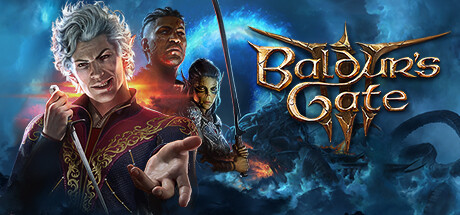
There are games that push the genre forward and there are games that smash the ceiling entirely. Baldur’s Gate 3 does the latter. After years in Early Access, Larian Studios shipped a full-fat, jaw-dropping, endlessly reactive RPG that makes almost everything else in the genre look timid. It is not perfect. Nothing this ambitious ever is. But it is, without question, one of the greatest games ever made.
A World That Actually Reacts to You
The thing that separates Baldur’s Gate 3 from the competition is not the production budget or the mocap performances, though both are extraordinary. It is the reactivity. This world responds to your choices in ways that feel genuinely surprising even dozens of hours in. NPCs remember what you did three acts ago. A decision you made in a throwaway conversation can close off or open up entire questlines. The game tracks an almost absurd number of variables and uses them against you constantly.
Character creation is deep enough to feel meaningful before you have even loaded into the world. With twelve main classes, numerous subclasses, and a full suite of background and race options all drawn faithfully from Dungeons and Dragons 5th Edition, you are making real decisions from the off. A Drow Sorcerer plays completely differently to a Human Paladin, and the world responds to both in distinct ways. That kind of systemic depth used to be reserved for tabletop games. Larian have bottled it.
The turn-based combat, meanwhile, rewards lateral thinking over button-mashing. You are not just hitting attack over and over. You are using high ground, shoving enemies off ledges, combining spells for environmental effects, and cursing yourself for forgetting to prepare the right spells before a fight. It is demanding and occasionally merciless, particularly on Tactician difficulty, but it is never unfair. When you die, you usually know why.
Playing Together
Co-op support for up to four players is genuinely one of the best implementations of multiplayer in any RPG. Each player controls their own character and has full freedom to interact with the world independently, which causes absolute chaos in the best way. One player can be charming a merchant while another is quietly picking their pocket. Decisions that advance quests can be taken without the whole group present. It is messy and brilliant and occasionally infuriating, and it is exactly what co-op in this genre should have always been.
Split-screen is available on PS5 for two players, and while it naturally shrinks the visual real estate, the game remains fully playable. Larian clearly put serious thought into how co-op would actually work rather than bolting it on as an afterthought.
Visuals, Performance, and Act Three
Baldur’s Gate 3 is a stunning looking game. The environments range from sunlit forests to the genuinely oppressive darkness of the Underdark, and the lighting throughout is exceptional. Character models hold up to close scrutiny in a way that many RPGs do not, which matters when so much of the game is told through conversation and facial expression.
The performance story is more complicated. On PC at launch, Act Three, which takes place in the city of Baldur’s Gate itself, had noticeable frame rate issues that became a topic of conversation in the community. It was clearly the most technically demanding section of the game and it showed. Larian have since patched these problems significantly, and by the time most people are reading this the experience should be far smoother. But it was rough at launch and worth acknowledging.
On PS5, the game runs solidly across most of the runtime, with Act Three again being the section that requires the most patience.
The Moments You Will Not Forget
Baldur’s Gate 3 is packed with set pieces that earn their place. There is a particular Act One encounter that players with a taste for chaos will never forget. The Goblin camp. The Underdark. The House of Grief. The game continually escalates without ever losing control of its pacing.
More than the big moments, though, it is the small ones that stick. A companion turning on you because of a decision you thought was reasonable. A dice roll at a critical story moment going catastrophically wrong and reshaping the next two hours. Finding a note in a chest that recontextualises something that happened six hours ago. These are the moments that make Baldur’s Gate 3 feel alive in a way that scripted games rarely manage.
Worth Knowing
- Act Three had genuine performance issues at launch on both PC and PS5, though patches have addressed most of these
- The game is enormous. A thorough playthrough can run to well over 100 hours
- Co-op is brilliant but requires all players to be on the same patch version
- The ending has multiple major variations, and some players have found certain outcomes unsatisfying – this is largely down to personal taste but worth knowing going in
- It uses D&D 5e rules, which can be opaque if you have no background with the system. The game does explain things, but expect a learning curve in the early hours
- Save frequently. This cannot be overstated
Verdict
Baldur’s Gate 3 is a generational RPG. That word gets used loosely, but it applies here in the literal sense: this is a game that will define what people expect from the genre for years to come. Larian Studios did not just make a great game, they made one that makes other great games look conservative. The reactivity, the depth, the co-op, the performances, the sheer number of meaningful decisions on offer – it all adds up to something that is genuinely difficult to walk away from.
A 10 out of 10 does not mean flawless. Act Three’s technical issues were real and the late-game pacing sags in places. But it means essential, and essential is exactly what this is. Play it.