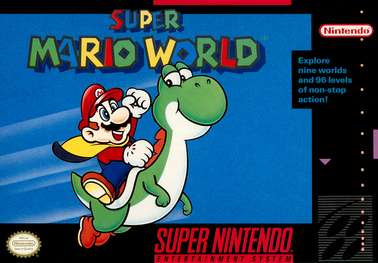
Super Mario World launched alongside the Super Nintendo in 1990 in Japan and 1992 in Europe, and if you were nine years old and this was the first game you played on your new console, the impression it made is probably still there. The colours. The sound of Yoshi appearing from an egg. The map screen that revealed more levels every time you thought you were near the end.
Nintendo was operating with the confidence of a company that had defined a medium and was now refining it. Mario 3 had been the peak of the NES era. Mario World took the same formula and added the dimension of space: bigger levels, more branching routes, more secrets per square metre than any previous Mario game.
Yoshi
The introduction of Yoshi as a rideable companion was the headline addition. He could eat enemies, gain abilities by eating certain shells (blue shell Yoshi could fly, yellow shell Yoshi could dig), and served as an extra hit point before being abandoned to the mercy of whatever you’d just run from. The morally ambiguous act of sacrificing Yoshi to make a difficult jump is among the defining video game decisions of the 16-bit era.
The cape power-up replaced the raccoon tail of Mario 3 and introduced sustained flight as a legitimate movement tool: mastering the cape’s spin-and-dive velocity maintenance allowed players to fly indefinitely, bypassing entire levels. Nintendo included a mechanic that broke the game and trusted players to decide whether to use it.
The Secrets
Super Mario World’s map contains more than the main path suggests. The Star Road levels, accessible through hidden exits, provide shortcuts through the world and secret switches that open routes to the Special Zone. Finding all 96 exits, rather than simply completing the game, reveals the full scope of what Nintendo built.
The secret exits in particular are a design lesson: they require players to apply knowledge the game taught them in novel ways. A key that must be carried to a locked door while avoiding damage. An exit at the top of a level rather than the right side. The discovery of each secret has the quality of understanding something rather than finding it.
How It Holds Up
Super Mario World is available on Nintendo Switch Online and plays flawlessly. The controls are precise enough that every death feels earned and every success feels deserved, which is the correct balance for a platform game.
The game has no significant rough edges. It was complete at launch in a way that launch titles rarely are, and thirty-five years of subsequent Mario games have not produced a 2D entry that unambiguously surpasses it. The argument that Super Mario World is still the best 2D Mario is not nostalgia. It is defensible.